
THE HUMAN PRODUCTION SYSTEM
I spent years inside manufacturing and aerospace environments. Production lines, assembly cells, root cause analysis, continuous improvement meetings, failure investigations.
Over time, I noticed something strange.
Factories and human beings break down in remarkably similar ways.
In manufacturing, collapse rarely looks dramatic at first. It begins as a small inefficiency everyone learns to tolerate.
A little more friction in the process. A little more instability. Something ignored because production is still moving.
Then eventually, the entire system becomes harder to operate.
Human beings are not much different.
Most people live with a level of internal friction they have mistaken for normal.
I: FRICTION
In engineering, friction wastes energy. It creates heat, reduces efficiency, and accelerates wear on the system.
Human beings experience friction too.
Poor sleep. Constant stimulation. Too much information. Digital overload. Unresolved emotion. Environments that never allow the nervous system to settle.
You can feel it after a few days of overstimulation. The mind becomes noisy. Attention fragments. Simple tasks begin feeling heavier than they should.
Most people assume this is normal because modern life trains the nervous system into constant stimulation.
But systems under continuous friction eventually lose stability.
II: SIGNAL
Every system depends on signal integrity. Once signal becomes distorted, performance becomes unpredictable.
Human beings are no different.
The nervous system is constantly responding to signals: light, sound, stress, conversation, music, food, environment, social media, thought patterns.
Modern technology made life more efficient. It also flooded the human mind with more input than it was ever designed to process continuously.
Most people never experience true silence anymore. The system is constantly reacting, processing, consuming.
After enough stimulation, perception itself starts degrading. Attention shortens. Thought fragments. The nervous system loses clarity between signal and noise.
Most people are living with their internal systems permanently running above operating temperature.
III: ROOT CAUSE
One of the most important principles in engineering is understanding root cause. You do not just react to visible symptoms. You investigate the condition creating them.
I think most people sense this intuitively, but rarely stop long enough to examine it honestly within themselves.
Burnout is rarely just workload. Anxiety is rarely just chemistry. Distraction is rarely just lack of discipline.
Most visible problems are downstream effects of deeper operating conditions that have gone unexamined for too long.
A person can meditate every morning and still remain overwhelmed by the environment they continue returning to. They can become disciplined while still surrounding themselves with noise, instability, poor inputs, and constant stimulation.
Systems eventually reflect the conditions they repeatedly operate within.
A system will continue producing the same outcome until the operating conditions change.
IV: MAINTENANCE
Factories require maintenance intervals. Without maintenance, degradation becomes inevitable.
Human beings are no different.
Most maintenance is quiet. Sleep. Silence. Time in nature. Solitude. Movement. Moments without constant input.
Most people already know what restores them. They can feel the difference after a few days away from noise, urgency, and overstimulation. The nervous system settles. Thought clears. Attention returns.
But modern systems are not designed around human coherence. They are designed around speed, output, stimulation, and constant engagement.
So people keep pushing themselves harder while ignoring the condition of the system itself.
In manufacturing, no intelligent operator would continuously run a machine at maximum load without downtime, inspection, lubrication, or calibration. Yet many people treat their own minds and bodies this way for years.
Then they wonder why the system begins resisting itself.
V: THE REAL WORK
The older I get, the less separation I see between engineering and awareness.
Both are attempts to understand systems. What weakens them. What destabilizes them. What restores order.
Real change is usually quieter than people expect. It rarely arrives through one massive breakthrough. More often, it begins through small corrections repeated consistently over time.
Cleaning your environment. Reducing noise. Protecting attention. Finishing what you start. Creating rhythms the nervous system can trust.
Most people underestimate how much their environment shapes their internal state. A cluttered environment changes thought. Constant notifications alter attention span. Constant stimulation fragments presence.
Systems adapt to repeated conditions whether those conditions are intentional or not.
This is why discipline matters. Not as punishment, but as structure. A way of reducing unnecessary chaos so energy can move cleanly through the system.
Small adjustments. Repeated consistently. Over long periods of time.
That is how systems change.
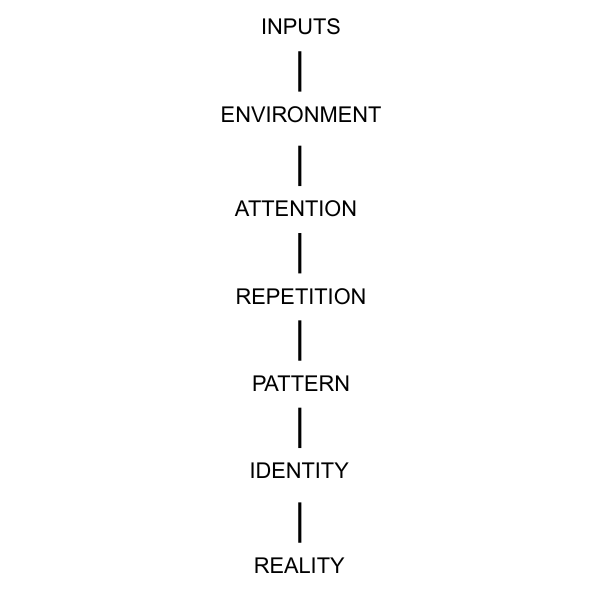
Your life is shaped by what you repeatedly expose yourself to.
Attention becomes habit. Habit becomes character. Character becomes destiny.
The system adapts to whatever it experiences consistently. Most people never realize they are training themselves every day.
The environments you return to, the thoughts you reinforce, the media you consume, the conversations you tolerate, the habits you repeat quietly over time. Eventually, all of it becomes structural.
In manufacturing, systems drift when they are left uncalibrated for too long. People drift the same way. Quietly. Incrementally. Almost invisibly at first.
Then one day, a person no longer recognizes the condition they have gradually normalized.
I think this is why awareness matters so much. Not as performance. Not as identity. Just the ability to notice what is shaping you in real time.
Because once you begin observing the system clearly, you can finally start participating in it consciously.
[BODY.TXT] — the extended field manual
[Sacred Objects] — the anchors
[Socials] — the fragments